README
World models keep popping up. Nobody has cracked multiplayer at scale, because multiplayer data is painful to gather. It takes three things, all on the same clock:
- every player's view
- every input they make
- the full game state
We put in the work. Vortech is a tiny team of 3 people, racks of GPU instances, and a couple years of plumbing. Below is what came out of it.
DATASETfree for research
Thousands of hours of 10-player first-person gameplay, free, so anyone can start building multiplayer world models. Licensed CC BY-NC 4.0, for non-commercial research and education.
state + actions, every player
aligned frame-by-frame
195M steps at 16 Hz
256² · 10 views per moment
ONE ROUND · TEN POVSground truth
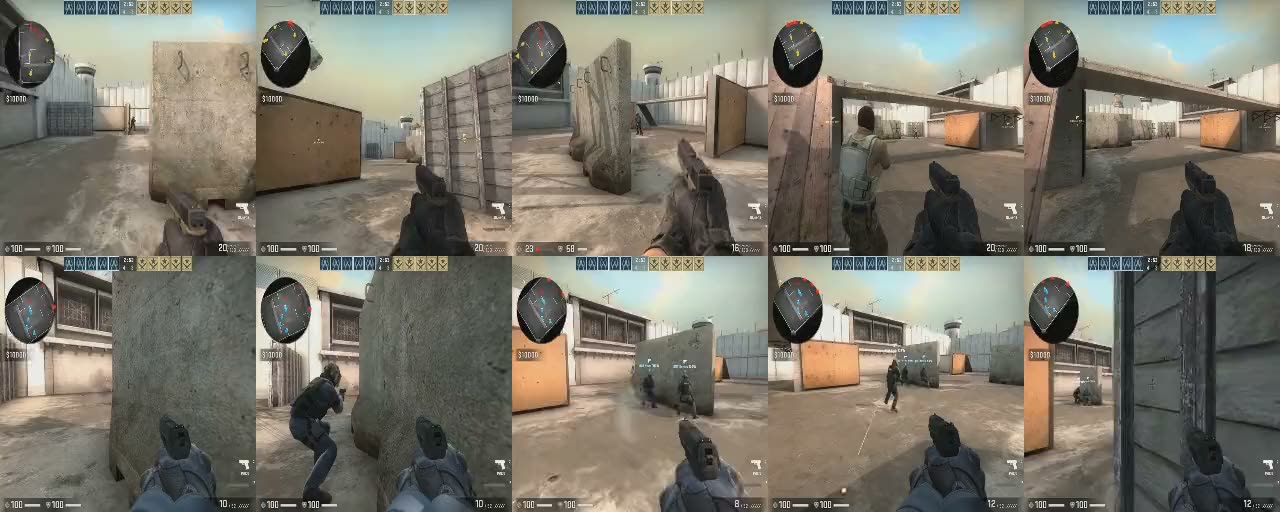
One bot round from the dataset, recorded from all ten players at once. Every view, every number and every hit sits on the same 16 Hz clock — pick a player and watch the others see them.
PIPELINEoh, by the way
The data comes from a pipeline that turns Source-engine games into unlimited multiplayer data, for anyone who holds the licence to the game, or is Valve itself. These games ship with bots and GOTV, a built-in recorder that captures every tick of every match. That is a perfect setup for automated data production: no players to recruit, no screens to capture.
First run: CS:GO, one map, 33 servers, five days. Gameplay generation scales linearly with compute. Other Source titles plug into the same steps, given the rights to them.
MODELoh, and by the waaay
We have been training a multiplayer world model on this for a while.It draws the next frame for each of the ten players, while a server keeps them all in the same game.It is a work in progress; we will put it out when it is good enough.
Meanwhile, a sneak peek: the recorded game on the left, the model on the right.
WHAT YOU CAN DO WITH THE DATA
- Train a multiplayer world model. Ten synchronized views of one shared world is the part nobody else has.
- Train your own bots. 195M steps of state → action pairs, with who-hit-whom damage labels.
- Study a game from the inside. Movement, aim, engagement geometry, all at tick precision.
- Point it at another game. The pipeline is described step by step; the recipe carries over to any Source title you hold the licence to (or all of them, if you are Valve).
Parquet + MP4, no pre-made splits, CC BY-NC 4.0 for non-commercial research. It lands on Hugging Face; this link becomes the dataset itself the day it goes up.
FAQ
Why bots and not human players?
Control and scale. We pick the map, the rules and the player count, and servers run around the clock. Expert bots move and fight plausibly enough to teach a model the physics, the map and the combat.
Why Counter-Strike?
Source games record complete demos by design, replay them deterministically, and can re-render any player's view after the fact. That is what makes ten aligned POVs per match possible. And if it has to be a Source game, it might as well be CS.
What exactly is in the data?
Per 16 Hz step: actions, poses, health, weapons and damage events for all ten players, plus 256×256 first-person video for the rendered subset. All of it is one map, aim_map_usp_s by im0rtus, with USPs on the CT side and Glocks on the T side. That is far from enough to build a world model of Counter-Strike; it is enough to experiment with, and to focus on the multiplayer part of world models. See the dataset spec.
Can I use it commercially?
No. Everything here, the game-state tables, the videos and the code, is CC BY-NC 4.0: free for non-commercial research and education, as long as you credit Vortech. The videos also show Counter-Strike: Global Offensive, which belongs to Valve, and we cannot grant any rights to Valve’s game. If you have a commercial use in mind, write to us; for the footage you would need Valve’s licence too.
When is the model coming out?
It'll be done when it's done. No date.
Who is behind this?
Three people. Meet the team.
Wanna talk?
Questions about the data, ideas for it, or something you are building on it: write to us. hello@vor.tech